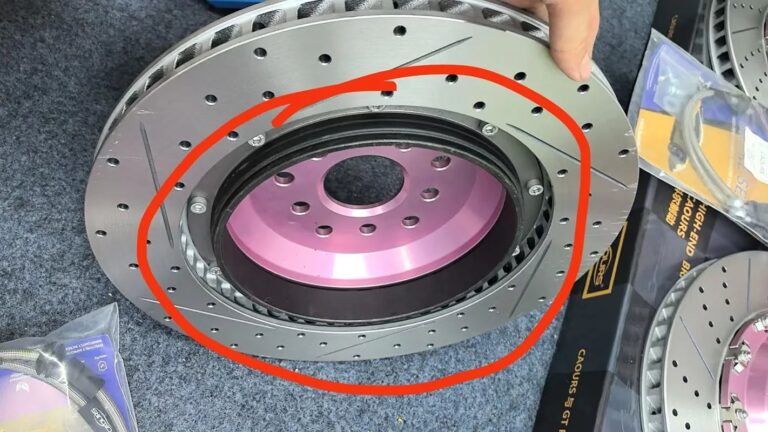
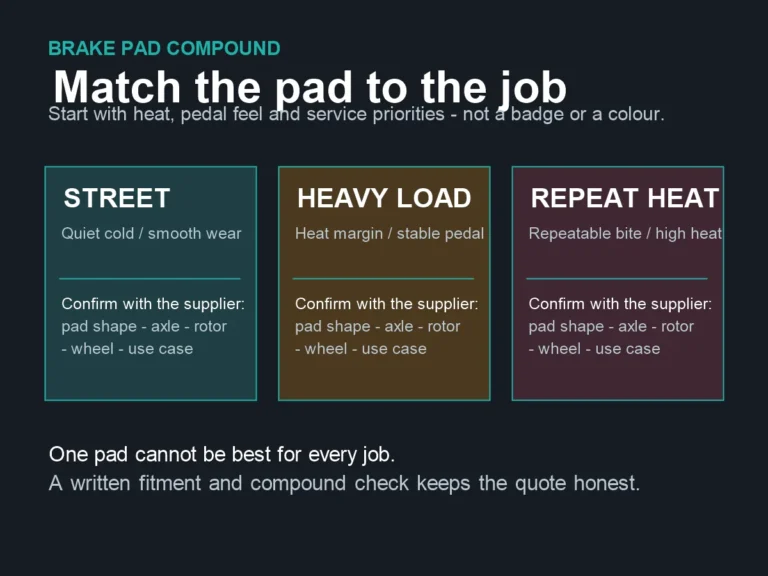
A Tacoma brake upgrade should begin with a fitment record, not a promise based on model year, piston count or wheel diameter. The correct review needs the actual vehicle, installed brake system, hub and rotor dimensions, wheel profile and intended axle scope. This checklist helps an owner, workshop or distributor collect those inputs before selecting hardware or requesting a quotation.
Start a Tacoma brake upgrade with measured data
A VIN can help identify the vehicle baseline, but it cannot prove the current wheel, hub, rotor, hose or previous modifications. Record the installed components and physical dimensions, then compare them with a kit-specific drawing or wheel template. Final approval should come from the supplier and a qualified installer for the exact configuration.
Define the upgrade scope before comparing kits
“Brake upgrade” can mean fresh pads and rotors in the original size, a larger front rotor, a caliper and bracket conversion, or a front-and-rear system project. These are different jobs. A useful enquiry identifies the axle, the reason for the change and the parts that must remain. It also separates a repair problem from a performance-oriented modification.
If the vehicle has a soft pedal, fluid leak, warning light, pulling condition or damaged component, diagnose that fault before treating a larger brake kit as the answer. This article is a planning guide, not a repair diagnosis or an installation manual.
| Project scope | Record first | Do not assume |
|---|---|---|
| Original-size service | Installed caliper, pad shape, rotor dimensions and axle details | Every Tacoma with the same year uses one brake package |
| Front caliper and rotor change | Wheel profile, hub, rotor, bracket, hose and caliper-envelope data | A larger wheel diameter guarantees caliper clearance |
| Front and rear project | Both axle configurations, parking-brake design and hydraulic review | Two independently fitting axle kits create a balanced system |
| Donor-part conversion | Exact donor references, machining, mounting, hose and service-part plan | A community swap applies to a different generation or trim |
Build one vehicle and brake record
The fitment file should describe the truck as it exists now. A VIN and registration information can identify an original baseline, while photos and measurements capture repairs, conversions and aftermarket parts that may no longer match that baseline. Keep the information for one truck together so the supplier does not combine details from different vehicles.
- VIN, market and model year
- Generation, trim and drivetrain as shown in vehicle records
- Front, rear or full-system project scope
- Clear photos of the installed caliper, rotor and hub area
- Any previous brake, suspension, wheel or hub modification
- Current wheel diameter, width and offset marking
- Tire size and balance-weight position near the caliper area
- Intended use stated as context, not a performance guarantee
Check wheel clearance in two directions
Nominal wheel diameter describes only part of the available space. A brake package also needs radial room around the rotor and caliper, plus axial room between the outer caliper body and the spokes. Two wheels with the same diameter can differ in barrel shape, width, offset and spoke curvature, so they can produce different results.
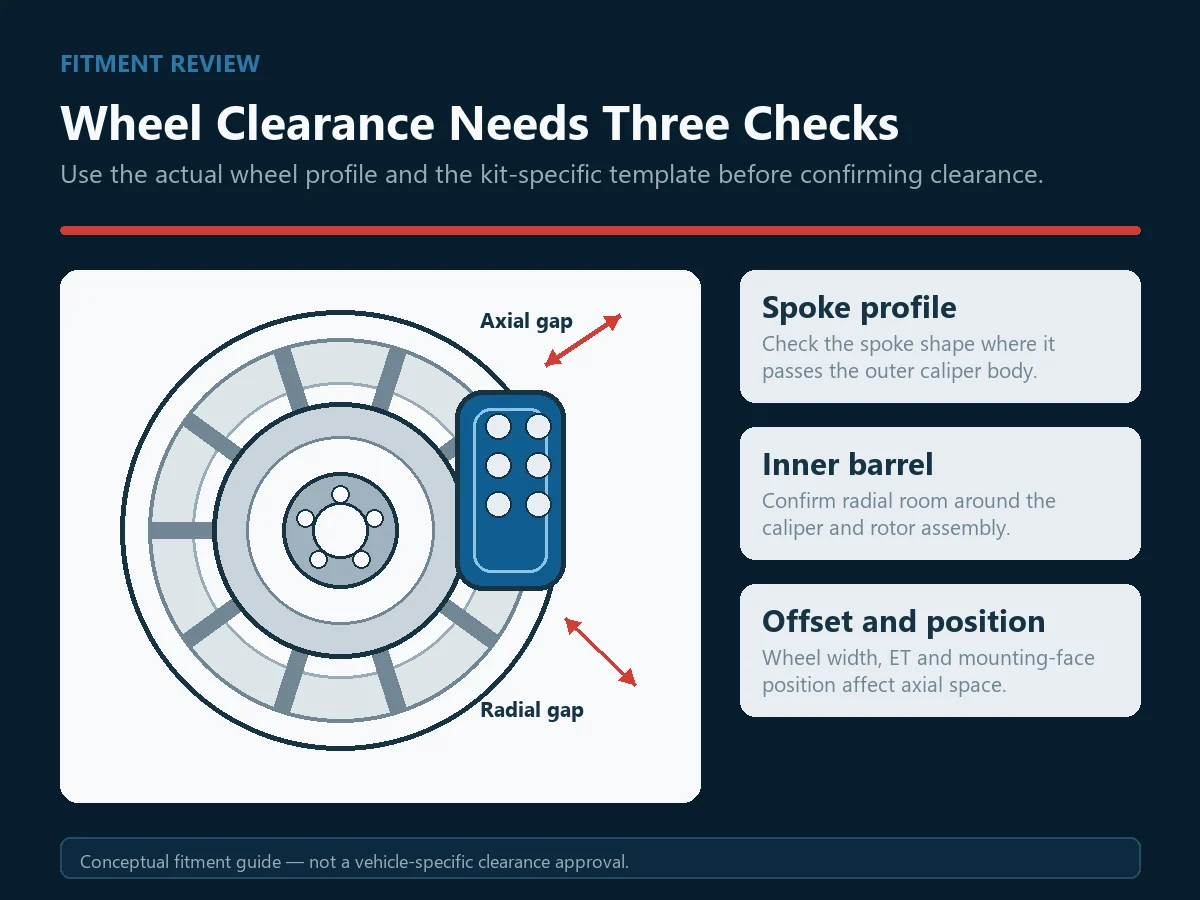
Record the wheel width and offset from the wheel markings, photograph the inner barrel and spoke shape, and note balance weights or other objects near the brake package. Use only a drawing or 1:1 template issued for the candidate kit. A generic diagram cannot confirm the final gap.
Do not add a spacer simply to make a drawing appear to clear. Spacer use can change wheel mounting, fastener engagement, track width and local legal or inspection requirements. Any proposed spacer should be reviewed as a separate vehicle modification.
Record rotor and hub data as separate fields
Rotor diameter is a useful first value, but it is not enough to position a disc between the pads or locate it on the hub. A complete review also needs rotor thickness, hat height or offset, centre bore, bolt pattern and mounting-face information. The supplier may request additional drawings or measurements for the bracket and steering knuckle.
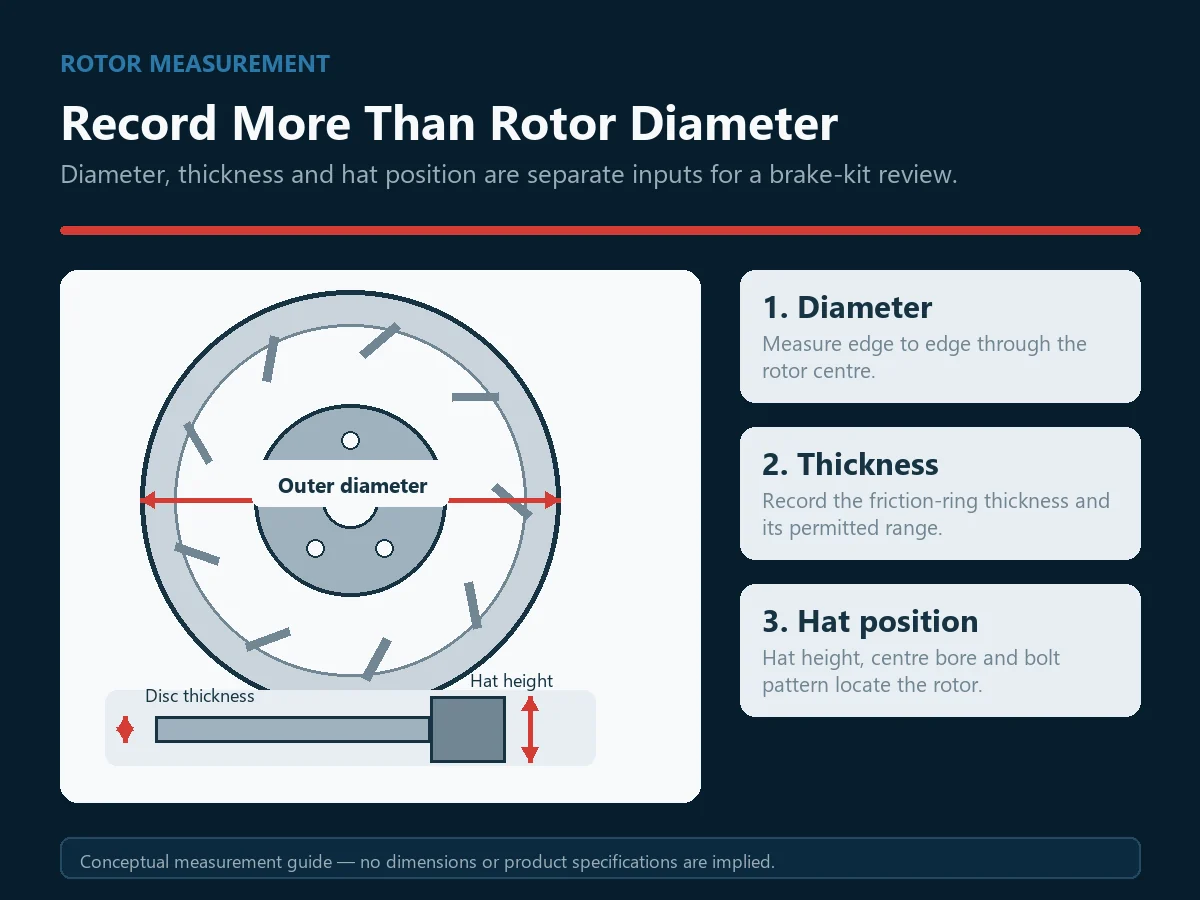
Use suitable measuring tools and record the method. Photograph each measurement so a reviewer can see the reference faces. When a value cannot be measured confidently, mark it as unknown rather than substituting a catalog number from a similar truck.
| Field | Why it matters | Evidence to send |
|---|---|---|
| Rotor diameter and thickness | Defines the friction ring the caliper and pads must accommodate | Measured values and photos of the measuring points |
| Hat height or rotor offset | Positions the friction ring relative to the hub and caliper | Section measurement or approved drawing |
| Centre bore and bolt pattern | Locates the rotor or hat on the hub | Measured values, hub photos and drawing when available |
| Hub and knuckle mounting faces | Controls bracket location and fastener geometry | Straight-on photos, dimensions and supplier-requested views |
| Caliper envelope | Allows wheel and suspension clearance review | Kit-specific outline or 1:1 template from the supplier |
Plan the installation and hydraulic review
A caliper and rotor that appear to fit in a static photo can still create installation problems. The final check may need full steering movement, suspension travel, hose routing, bleeder orientation, dust-shield clearance and access to fasteners. The installer should also review pedal travel, master-cylinder relationship, front-to-rear balance and any ABS or stability-control implications.
Without engineering evidence for the exact configuration, do not describe a kit as ABS compatible, road legal, direct fit or free of modification. Installation torque values, thread engagement, fastener grade, hose fittings and fluid requirements must come from approved documentation for the selected hardware.
Send a quote package that can be reviewed
A short message such as “Tacoma, 18-inch wheels” leaves the important variables unresolved. A useful request combines the vehicle record, measurements, photos and project scope in one submission. The supplier should then return a written candidate configuration with clear confirmed, conditional and unverified fields.
- State the exact truck and axle scope.
- Attach the wheel, rotor, hub and installed-brake record.
- Describe the intended use without requesting unsupported performance promises.
- Ask for the kit-specific caliper envelope or wheel template.
- Request a written bill of materials with quantities.
- Request included and excluded installation hardware.
- Ask for service pad, rotor, seal and hardware references.
- Confirm price, lead time, warranty, freight and returns separately.
For a vehicle-specific review, use the Vehicle & Brake Inquiry and include the checklist data. The response should separate confirmed inputs from candidate hardware and unresolved conditions before any order is placed.
Verify the received parts before installation
When a custom or vehicle-reviewed order arrives, compare the shipment with the approved quotation, bill of materials and drawings before altering a dust shield, opening sealed service items or fitting components. Photograph labels and each major part, count the hardware and stop if the delivered configuration differs from the written approval.
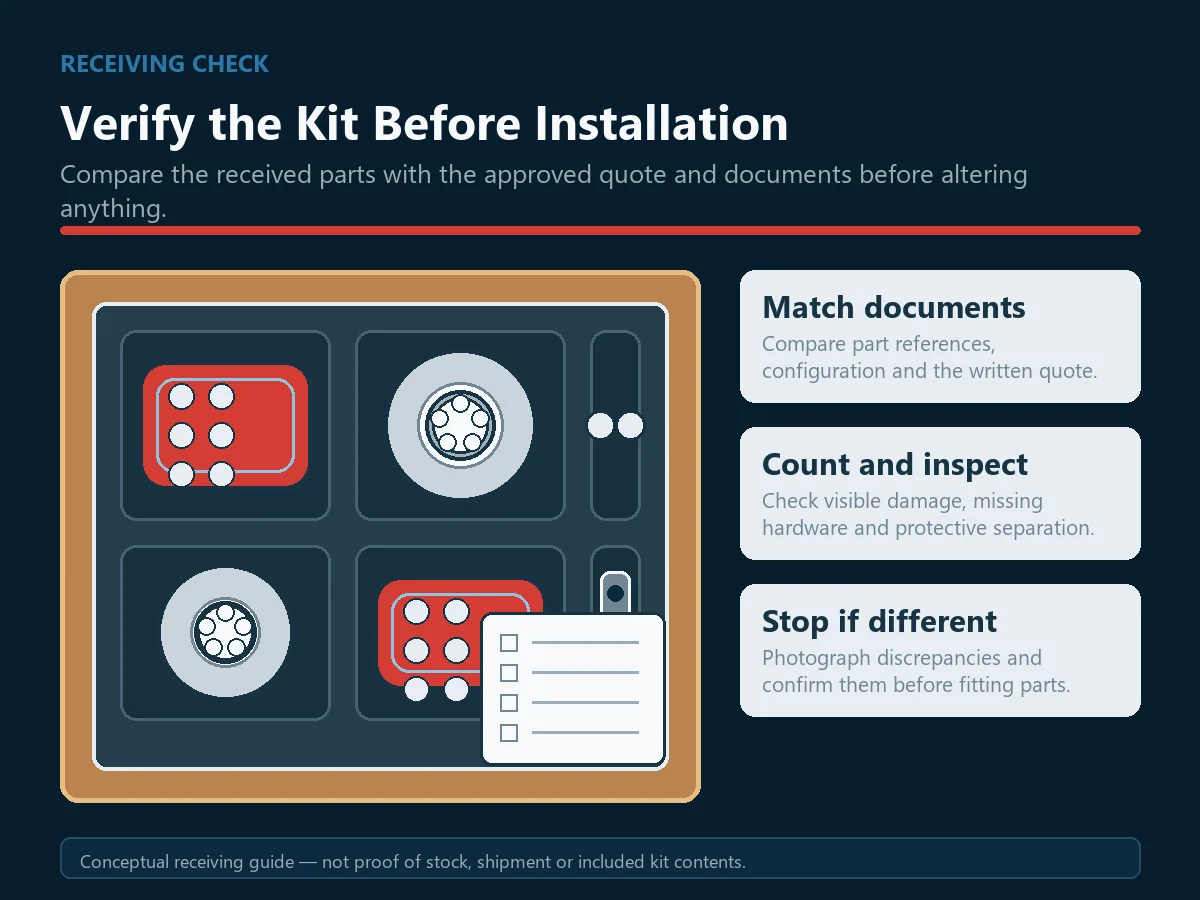
Match part references, side markings, rotor direction when applicable, brackets, hoses and fasteners to the written BOM. Visible similarity is not enough when two versions use different interfaces or offsets.
Treat Tacoma swap references as leads, not fitment proof
Tacoma forums contain long-running discussions about donor calipers, matching rotors and generation-specific swaps. They can help identify questions to investigate, but a part name or forum post does not establish that the steering knuckle, rotor position, wheel profile, hose path and hydraulic behavior match your truck. Save the source, then rebuild the claim as a parts-and-measurements file for the exact vehicle.
Tacoma brake upgrade FAQ
Will an 18-inch wheel clear a larger Tacoma brake kit?
Not from diameter alone. Wheel width, offset, inner-barrel profile, spoke shape and balance-weight position all affect the available space. Use a kit-specific caliper outline or 1:1 template against the actual wheel, then have the result reviewed before ordering.
Is a VIN enough to confirm Tacoma brake fitment?
No. A VIN can help identify the original vehicle baseline, but it cannot measure aftermarket wheels, current rotor dimensions or previous brake and hub changes. Pair VIN information with photos, physical measurements and an exact record of the installed components.
Can one guide cover every Tacoma generation?
No single guide should be treated as an approval for every year, generation, trim or drivetrain. Use general checklists to collect data, then validate the specific vehicle and candidate parts. Do not transfer a community conversion or product claim to another configuration without evidence.
Which rotor size should I choose for a Tacoma brake upgrade?
Rotor diameter is only one input. The selection also depends on thickness, hat position, centre bore, bolt pattern, hub and bracket geometry, caliper requirements and wheel clearance. Ask the supplier to explain the candidate configuration and the evidence used for approval.
Does a larger front kit require rear brake changes?
Not automatically, but front-only work still needs a system review. The installer or engineer should consider pedal travel, master-cylinder relationship, front-to-rear balance, rear brake condition and electronic-control implications. Avoid a blanket answer without the exact configuration.
What parts should a Tacoma brake-kit quotation list?
Request a line-by-line BOM with left and right calipers, rotors or hats, pads, brackets, hoses, fasteners and any required installation items. The quotation should also state exclusions, service-part references and which details remain conditional on final measurements.
Can I install the kit myself?
Brake-system work is safety critical. This article does not provide installation steps or torque values. Use the approved instructions for the exact parts and a qualified installer who can inspect routing, clearances, fasteners, bleeding, system behavior and local compliance before road use.
What should I send for a faster fitment review?
Send the VIN and vehicle baseline, axle scope, installed-brake photos, rotor and hub measurements, wheel size and offset markings, inner-barrel and spoke photos, modification history and intended use. Mark unknown values clearly and ask what additional evidence the reviewer needs.
References and Sources
- R1 Concepts: BIG BRAKES Need Specific Wheels: Tacoma Fitment Guide, dated July 6, 2026 in the current Google US result. Used only as a recent public signal that wheel-specific fitment remains an active question.
- R1 Concepts: SIZE MATTERS with Tacoma Big Brake Kit Sizing Specifications, dated June 26, 2026 in the current Google US result. Used only as a recent public sizing signal, not as evidence for a SteedLux configuration.
- TacomaWorld: Tacoma Brakes, Swaps and Tech, started January 4, 2017. This older community thread is used only to frame swap-verification questions, not as current buyer-frequency data or fitment authority.
- NHTSA Laboratory Test Procedure TP-135-01 for FMVSS 135. Evergreen regulatory reference showing that braking performance is evaluated at vehicle-system level; it does not approve an aftermarket kit or a specific installation.
Evidence limit: no source above proves compatibility, stopping-distance improvement, legal approval or the included parts of a SteedLux Tacoma kit. Final claims must come from the exact vehicle record and approved product documents.
Business Introduction
SteedLux Parts supports retail and wholesale brake-system enquiries through a vehicle and component review. The review route is intended to separate confirmed inputs, candidate configurations and unresolved fitment conditions before quotation. Product availability, final specification, price, shipping and warranty remain order-specific until confirmed in writing.
Contact Details
Include the VIN, axle scope, installed-brake photos, rotor and hub measurements, wheel markings and clearance photos. The team can then identify missing evidence and prepare a candidate configuration or quotation without treating the model name as fitment proof.